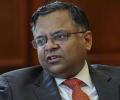
N Chandrasekaran, chairman of Tata Consumer Products (TCPL), stated that India continues to experience credible economic growth, driven by strong demographic fundamentals and accelerating digital public infrastructure, despite a fragmented global landscape.

The Bangalore Chamber of Industry and Commerce (BCIC) has welcomed the Karnataka Budget 2026-27, highlighting its focus on economic growth, support for MSMEs, and infrastructure development. Industry leaders have expressed optimism about the budget's potential to boost manufacturing, create jobs, and drive innovation in the state.

The Royal Swedish Academy of Sciences announced on Monday that it has decided to award the Nobel Prize in Economics 2025 to Joel Mokyr, Philippe Aghion, and Peter Howitt "for having explained innovation-driven economic growth." The 2025 Sveriges Riksbank Prize in Economic Sciences in Memory of Alfred Nobel goes to the trio, with one half awarded to Mokyr "for having identified the prerequisites for sustained growth through technological progress" and the other half jointly to Aghion and Howitt "for the theory of sustained growth through creative destruction."

'The outlook for the next Samvat is more constructive, as many of the earlier drags are gradually becoming supports.'

Economists highlight that resolving domestic policy bottlenecks, particularly through land reforms and improving the ease of doing business, will be critical for Prime Minister Narendra Modi's 'next-generation reforms' and India's economic transformation towards its 'Viksit Bharat' vision for 2047.

The World Bank has increased India's economic growth projection for FY27 to 6.6 per cent, citing resilient domestic demand, while simultaneously cutting its global economic growth outlook due to the conflict in West Asia.

Moody's Analytics predicts India will remain the fastest-growing major economy in 2026 and 2027, but its pace will moderate due to a global slowdown, geopolitical risks, and financial market volatility, despite the boost from AI demand.

S&P Global Ratings projects India's economic growth to slow to 6.6 per cent in FY27, down from 7.7 per cent in FY26, citing energy stress and a potential sub-par monsoon.
Fitch Ratings has affirmed India's sovereign credit rating at 'BBB-' with a stable outlook, acknowledging robust growth prospects and strong external finances. However, the agency highlighted concerns over elevated government debt, lagging structural metrics, and potential fiscal spending pressures due to rising youth unemployment.
Despite current headwinds, India remains the world's fastest-growing major economy and should not allow near-term challenges to obscure its long-term growth potential, said Jane Fraser, Citi Chair and Chief Executive Officer.
Minister of State for Telecom Chandra Sekhar Pemmasani urged BRICS nations to collaborate on building institutional capacity and advocating for fair standards in international telecom and ICT bodies. He highlighted India's willingness to share its modular, open-source digital public infrastructure frameworks like Aadhaar and DigiLocker, emphasising their role in sustainable development and economic growth across the Global South.

India's services sector experienced its weakest growth in four-and-a-half years in July, as new business orders, both domestic and export, eased due to intense competition and declining demand. Despite a modest rebound in job creation and improved profit margins, overall business confidence slipped, reflecting a broader slowdown in the economy.

Food and grocery delivery giant Swiggy has reported a significant narrowing of its net loss in the first quarter, down 34 per cent year-on-year to approximately 791 crore, while revenue from operations surged by 37 per cent to 6,812 crore. The company also achieved contribution margin break-even in its quick commerce segment, Instamart.

The number of individuals reporting a gross total income of 100 crore or more in their income tax returns has quadrupled to 576 in Assessment Year 2025-26, up from 142 in AY 2021-22, according to data shared in Parliament.

The Reserve Bank of India (RBI) has maintained its benchmark policy rate at 5.25 per cent for the fourth consecutive meeting, prioritising clarity on inflation trends, particularly concerning energy costs and geopolitical developments.

Fitch Ratings forecasts a 9 per cent aggregate revenue increase for rated Indian corporates in the current fiscal year (FY27), a stronger outlook compared to the 5 per cent estimated for FY26, which is expected to keep credit metrics stable despite potential global and domestic challenges.

Moody's Ratings has reduced India's GDP growth forecast for 2026 to 6 per cent, citing subdued private consumption, capital formation, and industrial activity due to higher energy costs and global uncertainties.

The Reserve Bank of India (RBI) maintained its key policy rates for the fourth consecutive time, keeping the repo rate at 5.25 per cent, while the benchmark BSE Sensex closed 152 points higher in a volatile session, recovering from an intraday dip.

Trade negotiations between the United States and Canada have collapsed, leading to the US imposing 50% tariffs on nearly $28 billion worth of Canadian imports, with Canada immediately vowing to retaliate dollar-for-dollar.

Following the Supreme Court's clean chit in the coal block allocation case, Congress leader Sonia Gandhi has lauded former Prime Minister Manmohan Singh's integrity and accountability, drawing a sharp contrast with the Narendra Modi government's operational style and alleged misuse of investigative agencies.
The International Monetary Fund (IMF) has reduced India's growth forecast for FY27 to 6.4 per cent, citing the potential impact of higher energy prices offsetting the country's economic resilience. Despite this, India remains among the fastest-growing major economies.

The last major business daily to launch in India was Financial Chronicle in April 2008, preceded by Mint on February 1, 2007.

A NITI Aayog report outlines India's potential to scale its bioeconomy to USD 691 billion by 2035 and USD 2.6 trillion by 2047, creating over 30 million high-value jobs. The report stresses the need for coordinated national execution, regulatory reforms, a strengthened talent pipeline, and a significant BioEconomy Growth Fund to achieve this vision, positioning India among the top biotechnology powers globally.

The Asian Development Bank (ADB) has revised down India's GDP growth forecast for fiscal year 2026-27 (FY27) to 6.6 per cent from an earlier 6.9 per cent, primarily attributing the change to elevated energy prices stemming from the Middle East conflict. Despite this moderation, India is still expected to remain the world's fastest-growing major economy.

Rental yield can indicate whether a property is undervalued, overvalued or fairly valued.

Union Finance Minister Nirmala Sitharaman announced the government's plan to establish a high-powered committee to examine reforms for the banking sector, aligning it with the vision of a 'Viksit Bharat' (Developed India) and India's next phase of growth.

A Niti Aayog report reveals that an estimated 8.7 crore Indian youth aged 15 to 29 are not engaged in education, employment, or training (NEET), underscoring the critical need for subsidised training programmes focused on self-employment and emerging sectors.
An independent study reveals that while Geographical Indication (GI) registration has boosted the identity of Kerala's traditional handloom products, it has not uniformly translated into economic benefits across weaving clusters. Challenges include an ageing artisan population, competition from powerloom products, rising raw material costs, and inadequate marketing.

State Bank of India Chairman C S Setty has expressed support for a 'pause' in policy rates by the Reserve Bank of India's monetary policy committee, believing it will help stabilise conditions and support economic growth. He also urged investors to look beyond short-term equity market movements and focus on India's structural transformation, driven by reforms and digital infrastructure.

A recent SBI Economic Research report indicates that the significant gap between credit and deposit growth, currently over 530 basis points, is likely to persist if geopolitical risks and external supply shocks continue. However, an improvement in deposit growth is anticipated with inflows into foreign currency non-resident (bank) deposits.
Commercial banks in India recorded their highest credit growth in two years, accelerating to 18.6 per cent year-on-year by June 27, while also mobilising nearly 7 trillion in deposits, marking the third-highest fortnightly deposit growth in 29 years.

Not a single retail outlet ran dry. Every household that wanted a cylinder got one. India faced neither a 1991 moment nor a 2013 one. Macroeconomic stability held. This was not an accident, and it was not luck alone. It was the work of a government that chose to act as it had during the pandemic -- deliberately and gradually, building one measure upon another rather than reaching for a single dramatic lever, explains V Anantha Nageswaran, chief economic advisor to the Government of India.

India's Goods and Services Tax (GST) collections saw a significant 14 per cent increase in June, reaching approximately Rs 1.95 lakh crore. This surge was primarily driven by a substantial 34.6 per cent growth in tax mop-up from imports, alongside a 6.5 per cent rise in domestic supplies, reflecting the country's economic resilience despite global uncertainties.

'Periods of heightened volatility, driven by global events such as tariffs and geopolitical tensions over the past year-and-a-half, can make some investors pause or discontinue their investments.'

Info Edge (India), the company behind Naukri.com, has seen its startup investment portfolio, spanning AI, deeptech, and consumer tech, grow to Rs 41,300 crore from an investment of Rs 4,900 crore since 2007. This significant valuation increase comes despite headwinds in its core recruitment business, which has been impacted by weak hiring trends and IT sector uncertainty.

FPIs have already withdrawn Rs 2.6 trillion from Indian equities in 2026, exceeding the outflows recorded in any previous full calendar year.

The Reserve Bank of India has marginally increased its GDP forecast for the current fiscal to 6.7 per cent while slightly lowering the inflation projection to 5 per cent. The central bank noted that while domestic economic activity shows resilience, global turbulence, particularly re-escalating conflicts and volatile oil prices, continues to pose risks to the inflation outlook.

Skoda Auto is strategically navigating the competitive Indian automotive market by prioritising profitable growth, exploring new powertrain options like CNG and a limited diesel return, and gearing up for a locally produced electric SUV, all while expanding its retail footprint.

'A favourable base, last year's policy measures, the carryover impact of a good monsoon and improving earnings should all help.'

The Indian stock market's trajectory this week will be significantly influenced by crude oil prices, global market trends, and the commencement of the corporate earnings season, with IT major TCS set to announce its June-quarter results on July 9.
